Toxicology

Toxicology

This topic warrants a separate discussion.

The early plastics colourist’s palette was dominated in the yellow, orange, red part of the colour spectrum by cadmium and lead containing pigments.  Both types produce bright, opaque full-shade colours.  Cadmium shades are slightly cleaner, brighter and cover a wider part of the colour spectrum, extending into greener yellows and bluer reds.

When it came to colouring plastics, organic pigment manufacturers (mostly German and Swiss companies) had a difficult time penetrating the yellow-orange-red area.  In general the ‘organic equivalents’ had worse heat-stability, lower migration resistance, were not cost-effective and tended to undesirably nucleate resins.

What’s more, most of the cadmium colours could not be matched with available organic pigments in full-shade – they were brighter than their organic counterparts.  The very bright monoazo Pigment Red 170 was an exception; consequently it was widely used in polyolefins in spite of its’ borderline migration resistance and medium heat-stability of ~240°C.  The relatively recent introduction of bismuth vanadate yellows and DPP reds has made it possible to match more full-shade cadmium colours, but some remain out of reach.

Environmental, health and safety issues have been a feature of social politics in recent decades.  These can be broadly grouped into toxicity issues, material handling issues and migration/contamination issues.

Material handling is not difficult to deal with – manufacturers can be bullied by legislation into adopting very tight controls.  Migration/contamination issues represent a huge topic, which others are more qualified to address.  This leaves toxicity issues…

There is no direct evidence of heavy-metal containing plastic colorants causing harm. During the latter part of the 20th century, in order to promote their products, organic pigment manufacturers successfully lobbied legislative bodies to demonise these pigments by raising doubts and implying negative consequences.  The impact of this continues to reverberate in today’s social and political climate.

The manufacturers of heavy metal-containing pigments (mostly English companies) did a poor job of defending their products and did not counter attack by pointing out the environmental hazards associated with organic pigment production.  Some of the intermediates used in azo pigment production like dichlorobenzidine, 2-aminobentriflouride, dichlorobenzene and orthoanisidine can be poisonous, carcinogenic, explosive, etc.  Moving their production to China and India does nothing to ultimately solve the problem.

The organic pigment producers didn’t have it all their own way.  By the 80’s the diarylides (which represent most of the useful disazo pigments) were also removed from the plastic colourist’s palette.  They are known to generate carcinogenic 3,3’-dichlorobenzidine during their decomposition so they are now only recommended for low temperature (up to 200°C) plastic applications.

In Australia and New Zealand, AS2070-1999 Plastics materials for food contact use states –

Colourants: Colourants used in plastics materials for food contact use shall comply with the Council of Europe Resolution AP(89) 1, Resolution on the use of colourants in plastics materials coming into contact with food and with any subsequent amendments or revisions.

At present AP(89) 1 sets 0.1M HCl extractable limits for Cd, Se, Ba and Pb at 100 ppm, and hexavalent chromium at 1000 ppm.  These limits are relatively easy to comply with, but manufacturing is increasingly aimed at a global market.  With bismuth vanadate yellows and DPP reds providing more viable alternatives than were available before their introduction; and countries like Japan (world’s third largest cadmium producer) effectively banning lead and cadmium pigments, the overall trend seems to be towards a continuing slow reduction in the usage of pigments based on heavy metals.

Picture of Jon Paul
Jon Paul

So far I am the only author on this website but this might change
© Vibron 2018

Pigment levelling through nucleation

Pigment Levelling through Nucleation

Nucleating additives increase the polymer’s crystallization temperature and its rate of crystallization.  This can improve physical properties, control warpage and improve processing speed.  Clarifiers are nucleating additives that also generate optical property improvements.  Nucleants are commonly used, especially in PP, to confer those benefits.

All pigments consist of particles, which provide sites for polymer crystallite formation and tend to increase the crystallization temperature.  MD (machine direction) and TD (transverse direction) shrinkage are two important parameters. When compared to uncoloured polymer, inorganic pigments generally have little effect on overall properties or the MD to TD ratio.  Many organic pigments, especially phthalocyanines, can drastically alter shrinkage and the MD to TD ratio producing undesirable effects.  When we say that a pigment has a tendency to nucleate resins, this is not considered a good thing.  We are saying that it is likely to result in –

  • The need to alter moulding conditions for every colour in a product range because each affects shrinkage differently.
  • Warpage due to frozen-in stresses.
  • Loss of impact strength or even stress-cracking due to frozen-in stresses.

These negative effects manifest most strongly in HDPE and PP Copolymer.  As a result, organic pigments that cause nucleation can’t be used in certain applications.  Some pigment manufacturers offer modified, low nucleation versions of their products.  These are generally weaker, incur a cost premium, and don’t always eliminate the problems.  Sometimes the only solution is to reformulate using a different class of pigments.  Often the new formulation is more expensive and can’t accurately replicate the original shade.

In theory, if the positive effects of a nucleating agent can outperform the nucleating effect caused by the various pigments, the negative nucleation effects will disappear and all coloured articles will behave in the same way.  Warpage and stress cracking will be eliminated and moulding conditions will not need to be altered for each colour.  Pigment levelling is the term commonly used to describe this effect.

The plastics colourist would greatly benefit from a nucleant or nucleant mixture capable of reliable pigment levelling in polyolefins, especially HDPE.  Simplified pigment inventory and ability to match a wider colour range at competitive prices are two obvious advantages.  Ideally, any pigment levelling nucleant should be effective in low concentrations, be easy to incorporate into concentrates and add little to the formulation cost.  We are not at the ideal stage yet, but edging closer.

There are many commercially promoted nucleating agents.  They create heterogeneous nucleation sites in the polymer melt so crystallization is initiated at higher temperatures. Some, like Sodium Benzoate, Talc, Silica, PTFE and Hyperform HPN-20E recently introduced by Milliken, remain solid at processing temperatures.  For maximum efficiency these should be present in nano form to generate the highest density of nucleation sites.  This increases costs.  Sorbitol derivatives and organic acid derivatives are examples of additives that partly dissolve in the polymer melt during compounding.  They then crystallize on cooling into a fibrillar network providing a huge density of nucleation sites.

Most nucleant research has focused on reducing cycle times, physical and optical property improvements, because such benefits are easy to sell.  PP and PET have benefited the most because they are relatively easy to nucleate.  Development of effective nucleant systems for HDPE has been slow. This is frustrating for the plastics colourist because pigment levelling nucleants are most useful in HDPE.

In my experience, Sodium Benzoate, which has been used for a very long time, deserves some respect as a pigment levelling nucleant.  It has solved warping problems for me in the past.  There are now many powerful nucleating agents to choose from and perhaps the colour industry should be conducting its own tests.  After all one can hardly expect Milliken or Adeka to be suggesting something other than one of their own products.  The most effective pigment levelling nucleant could turn out to be a blend of two or more components (several Adeka nucleants are blends rather than single chemicals).

If the pigment levelling nucleant adds extra costs, it will be much more readily accepted by the plastics processor, if it also adds value by increasing processing speed and improving physical properties of the finished item.  Perhaps the colour suppliers, whilst solving their problems, should aim to create a win-win scenario.

Picture of Jon Paul
Jon Paul

So far I am the only author on this website but this might change

© Vibron 2018
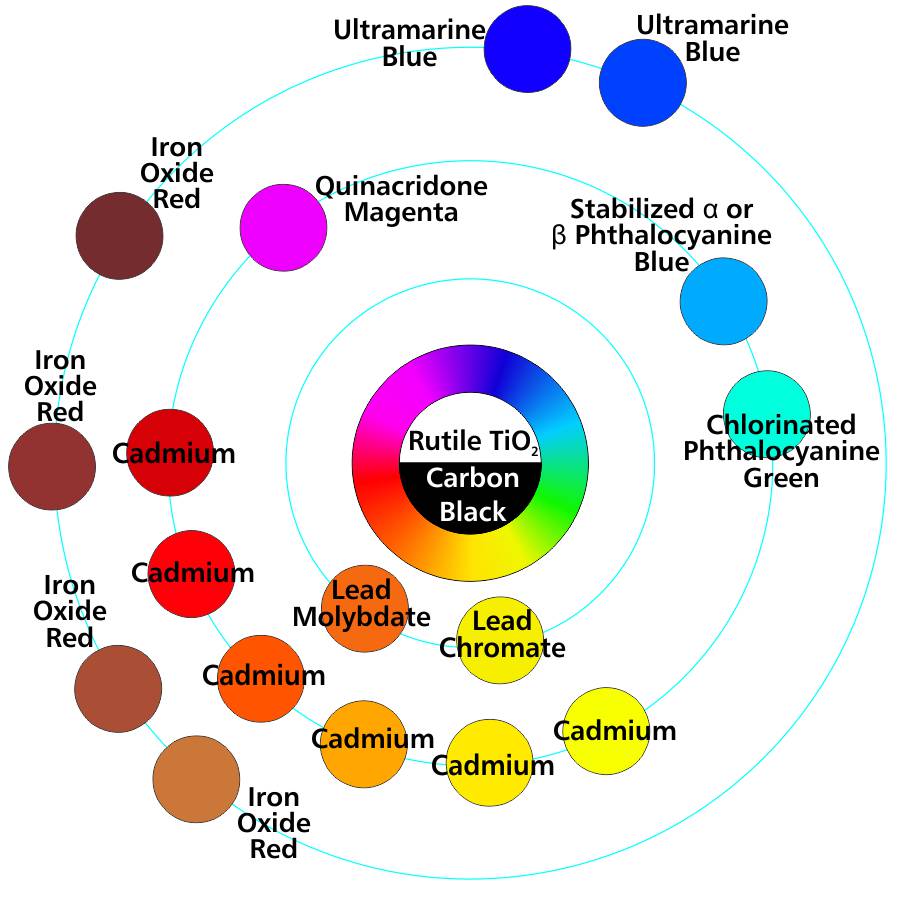
High performance pigment palette for polyolefins – changes over time

How the high performance pigment palette for polyolefins changed over time

These have not changed

A laboratory producing custom colours for all types of polyolefin convertors needs a base range of pigments that will be problem free in most applications.

When establishing a core pigment palette aimed at high performance polyolefin applications, the key properties we are looking for are –

  • Heat stability approaching 300°C.
  • Light fastness approaching 8. 
  • Weather fastness approaching 5
  • Migration resistance of 5.

I am ignoring any tendency the pigment may have to nucleate resins.  Nucleation is a big and important topic that is better tackled separately. 

White and Black must be included in any palette.

White is present in almost every colour formulation.  Rutile TiO2 has been the obvious white choice for many years.

Carbon Black also tends to find its way into most colour matchings as a tinter.  Carbon black is structure forming.  It has a tendency to disperse further during processing causing a change in shade.  It is easier to obtain consistent colour matching results by using coarser, low-structure blacks as tinters.  These produce bluer greys in reduction, which can also be an advantage.

Iron Oxide Reds are also must-have pigments. Dull in top-tone, they reduce to relatively bright pinks, display very high opacity and tint strength.  Their terra cotta shades range from orange-red to burgundy.

Rutile TiO2, carbon black and iron oxide reds all score top marks in the four key properties.  They are also amongst the least expensive of all plastics colourants.

Chemically related to Lapis Lazuli, Ultramarine Blues are low in cost, bright, weak and translucent.  They can be blended with phthalocyanine blue and quinacridone magenta to produce most of the shades in the cyan to magenta part of the colour spectrum, including violets.

Post World War II, Phthalocyanine Blues and Greens have ‘owned’ the mid blue-cyan-green part of the colour spectrum in all but the most demanding applications.  Normally used in combination with white, they are low in cost, exceptionally strong and bright.  Their ‘key properties’ performance sets the standard by which other organic pigments are judged.

Although relatively expensive, Quinacridone Magenta is another ‘must have’ organic pigment.

These are getting replaced

Before the mid-70s, Cadmium based and silica-coated Lead-based pigments dominated the yellow-orange-red high performance areas.  In full-shade, both types produce very bright, opaque colours that organic pigments struggle to match.  As with all inorganics, their undertones and reduced shades are not particularly bright (I hope no artists are reading this).  For that reason, every colour lab had to keep some organic yellow-orange-red pigments on hand to deal with ‘difficult’ shades.  I did not include those on the ‘early palette’ diagram because back then they were of secondary importance and not part of the core high performance polyolefin palette.

With Cadmium and Lead becoming phased out for toxicological reasons, viable alternatives had to be found to take their place.

The new core pigment palette

The demise of lead and cadmium pigments has opened opportunities for other pigments in the yellow-orange-red areas. 

With patents lapsing and prices dropping, DPP Reds now deservedly dominate the red part of the spectrum.  They can be sourced at similar prices to cadmium red, have similar top-tone brightness, are brighter in reduction and at least twice as strong.  As a result cadmium reds have now become the ‘niche’ colourants.

I see no clear winners in the mid-orange to greenish yellow area.  Bismuth Vanadate is a contender, but its price-to-strength ratio makes some high performance organics look attractive, especially when styling colours that don’t require high full shade brightness and opacity.  Isoindolinones, benzimidazolones and azo condensation pigments are the main chemical types competing for a slice of this market segment.

Though some would argue that these introduce unnecessary complexity, I have added zinc ferrite tan and brominated phthalocyanine green to the core post-cadmium and post-lead palette.  They go a small way towards offsetting the high cost of performance yellows.

Thin gauge products

Different rules apply to a palette aimed at the thin gauge area of the plastics processing industry. The brilliant organic pigment undertones are very attractive in thin gauge products, so organics have always been the colourants of choice for film, stretched tape and fibre, especially as processing temperatures in those areas are often relatively low.  Also, any disposable items, like shopping bags, have low colour fastness requirements.

Picture of Jon Paul
Jon Paul

So far I am the only author on this website but this might change

© Vibron 2018